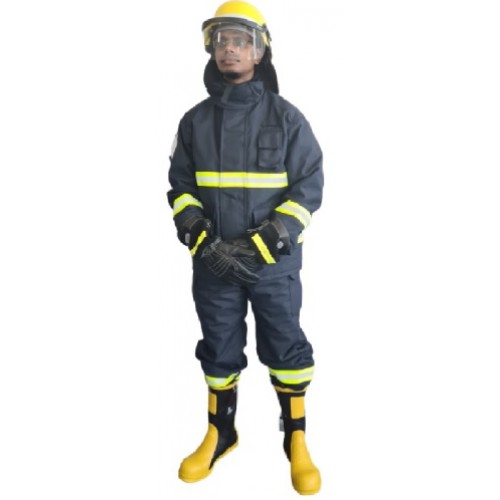


IMPA 330901 FIREMAN'S SUITS COMPLETE RS, FIREMAN SUIT NOMEX, COMPLETE, SOLAS/EN469
- Product Code: FIREMAN SUIT fireman's suit x2 y2 z2
- Product SKU:
- Item Code: PICK-RSG-FSUIT-03
- Availability: In Stock
330901 FIREMAN'S SUITS COMPLETE
IMPA Code:
330901
UOM:
SET
MTML UOM:
SET
Required according to SOLAS regulations Chapter II Regulation 17. “All ships shall carry at least two fireman’s outfits complying with the requirements.” In addition, two fireman’s outfits shall be provided for tankers. One set contains Protective clothing, Boots, Gloves, Helmets, Electric safety lamp and Axe. However, Electrical safety lamp and Axe are not included in the unit.
|
FIERMAN'S OUTFITS COAT 消防员装备上衣 |
330912 |
RS, FIREMAN SUIT NOMEX, COMPLETE, SOLAS/EN469
fire fighting suit singapore
(Part of fireman's outfit solas requirements)
FIREMAN SUIT NOMEX, COMPLETE, C/W: SOLAS/EN469
a) Jacket + Trousers, BLUE, RSZD-F, Size: L
b) Helmet 2MZP
c) 5-Fingers Gloves 2MZO
d) Etche Fireman's Boots
e) Carrying Bag
The Complete SOLAS Fireman’s Outfit offers unparalleled protection and performance for professional firefighters. Its SOLAS certification ensures that it meets the highest international standards for marine firefighting, making it the perfect choice for firefighters working on ships and other marine vessels. Additionally, its advanced materials and construction provide superior comfort and durability, allowing firefighters to focus on the task at hand without worrying about their equipment.
FIREMAN'S SUIT COMPLETE SET, ARAMID FIBRES, NON- ALUMINIUM, SOLAS APPROVED, WITH CERTIFICATE
The Fireman Suit is a two-piece garment with a four - layer construction.
The outer shell is Nomex one type of Meta aramid.
The second layer is a waterproof breathable membrane.
The third layer is an meta-aramid/para-aramid felted thermal barrier and the fourth layer is a aramid lining.
The jacket has a stand up collar, elasticated cuffs, and is closed by a zip covered by an overlapping front with touch and close fastening to the front and collar.
The trousers have wide
elastic braces with adjusters and quick-release
buckles
Tier 1 HRI Firefighting Suit
fire fighter suit
BUNKER SUIT/ BUNKER GEAR
bunker gear
bunker suits for firefighters
fire fighting bunker gear
EN469 standard Firemans outfit
EN469:2020 (X2,Y2, Z2), MED
FIREMAN OUTFIT SUITS COMPLETE SET (EUROPEAN NORM EN469 STANDARD)
EN469 IMPA Code 330911 Fireman’s Outfits
Firemans coat unlined, UK, DOT/USCG Approved required as per SOLAS regulation
Firemans trouser unlined, UK, DOT/USCG Approved required as per SOLAS regulation
Reference: ABS Regulatory News - No. 06/20244
INDUSTRY REMINDER ON FIREFIGHTING SUITS
It
is essential for shipowners to equip their crew with suitable firefighting gear
to ensure the preservation of lives and vessels in the event of a fire. The
appropriate equipment should enable crew members to effectively combat fires in
open-air environments and enclosed spaces, all while ensuring their personal
safety.
PSC PERSPECTIVE
Port State Control Officers (PSCOs) have repeatedly issued
deficiencies
against the Maritime
Labour Convention (MLC)
when firefighting suits lack the appropriate certification for firefighting in enclosed
spaces. PSCOs on numerous interventions have stated that proximity suits, which are designed for open-air
firefighting, do not offer adequate thermal protection against radiated heat
when entering enclosed spaces where a fire is present. As proximity suits are
compliant with the International Convention for the Safety of Life at Sea
(SOLAS) and the International Code for Fire Safety Systems (FSS Code), it is
the opinion of some PSCOs that they may only be utilized for supportive tasks
such as boundary cooling.
Some PSCOs are inferring that proper firefighting clothing should
provide a level of protection at least equivalent to the gear worn by the crew
during exercises for obtaining the Seafarers' Training, Certification and
Watchkeeping (STCW) Code A-VI/1 Basic and STCW A-VI/3 Advanced firefighting
certifications.
INTERNATIONAL REQUIREMENTS
SOLAS Chapter II-2 Regulation 10 mandates the minimum number of firefighting outfits on board ships.
According to Reg.10.10.2, all ships must carry
at least two outfits (Reg.10.10.2.1), with additional suits required for passenger ships, gas
carriers and tankers (Reg.10.10.2.2). Additionally, Reg.10.1.1 stipulates that firefighting outfits
must comply with the FSS Code, detailed
in Chapter 3, which outlines engineering specifications for
personnel protection.
|
SOLAS
Ch.II-2/Reg.10.10.2.1 |
All ships must carry at
least two outfits |
|
SOLAS Ch.II-2/Reg.10.10.2.2 |
Additional suits required for passenger ships and tankers |
|
SOLAS Ch.II-2/Reg.10.1.1 |
Firefighting outfits must comply with the FSS Code |
|
FSS Ch. 3 |
The personal
firefighting equipment shall include “protective clothing of material to
protect the skin from the heat radiating from the fire and from burns
and scalding by steam. The outer
surface shall be water-resistant.” |
MLC Regulation 4.3 / Standard A4.3 serves as a legal framework for
promoting health and safety protection and accident prevention within the
maritime industry. It establishes a
baseline for these essential aspects, while the flag Administrations are responsible for enacting specific
MLC compliance requirements
through their respective national legislation. MLC 2006 Guideline B4.3 - Health and
Safety Protection and Accident Prevention, although non-mandatory, mentions
that firefighting should be addressed and highlights the importance of considering the International Labour
Organization (ILO) code of
practice titled Accident Prevention on
Board Ship at Sea and in Port, 1996 as a reference for occupational safety
and health protection. Notably, the
ILO code provides guidance on conducting fire drills and identifies enclosed
spaces such as engine rooms and accommodation spaces as critical locations for
fire scenarios.
FIREFIGHTING SUIT STANDARDS
Many suits on board are designed in accordance with the EN 531
standard. However, this standard is designed for industrial workers exposed to
heat and is not intended for firefighting. Moreover, some suits labeled under
EN 531 feature unprotected metal zippers, buttons or clasps, which can conduct
heat and cause burns.
A protective suit meeting the demands of firefighting is one
complying with the European standard EN 469:2005, as noted below. Level 2 is
required for firefighting in enclosed spaces. EN 469:2005 and its revised
version EN 469:2020 also mandate a risk assessment to be made.
|
EN 469:2005 |
Suits are classified into
performance level 1 or level
2 using four
criteria indicated by a
pictogram:
·
Resistance to convective heat (Xf1 or Xf2) ·
Resistance to radiant heat (Xr1 or Xr2) ·
Resistance to water penetration (Y1 or Y2) ·
Water vapor resistance (Z1 or Z2)
Suits labeled
as level 1 or level 2 are common in the market. Level 1 is limited to outdoor
firefighting and support activities, while level 2 is recommended for
firefighting in enclosed spaces or structures with higher fire risk. Only
suits with Xf2, Xr2, Y2 and Z2 are considered level 2 suits.
The resistance
of the garment to water penetration is determined by its hydrostatic pressure
properties, while the water vapor resistance is associated with its
breathability. The use of high-visibility materials in the garments is not
mandatory, but if included, they must meet the thermal and high visibility requirements specified
in the standard. |
|
EN 469:2020 |
The European
standard for firefighter protective clothing, EN 469, underwent revisions in
2020. Based on the updated standard EN 469:2020, there are three criteria
classified as level 1 or level 2:
·
Thermal Performance (X1 or X2) ·
Water Penetration Resistance (Y2 or Y2) ·
Breathability/Water Vapor Resistance (Z1 or Z2)
Specifically,
the difference in Water Penetration Resistance is that level 2 (Y2) fire
suits include a moisture barrier, while level 1 (Y1) fire suits do not. It's
important to note that both types of fire suits, with or without a moisture
barrier, are approved according to EN 469:2020.
In the updated
standard, performance levels are exclusively determined by a garment’s thermal
performance, with X now representing both radiant heat
and flame contact heat.
Level 1 meets
lower requirements suitable only for outdoor
firefighting, while Level 2 meets higher
standards necessary for structural firefighting operations, including indoor and
enclosed spaces. Notably, the garment's pictogram still
RS, FIREMAN SUIT NOMEX, COMPLETE, SOLAS/EN469 fire fighting suit singapore(Part of fireman's ou.. |