
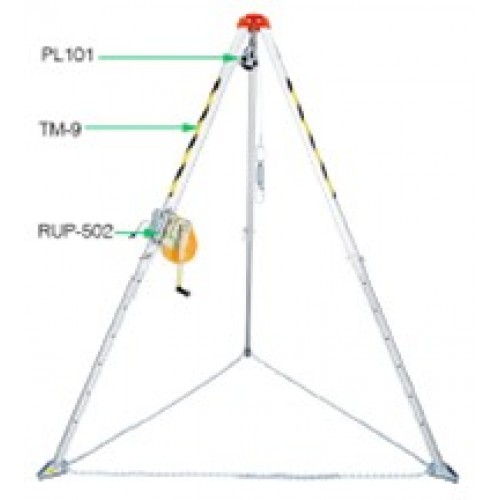
PROTEKT CONFINED SPACE EQUIPMENT - tripod stand with winch for confine space
- Product Code: TM9 + RUP-502
- Product SKU:
- Item Code: PICK-PRO-CSCP2
- Availability: In Stock
PROTEKT CONFINED SPACE EQUIPMENT - tripod stand with winch for confine space
PROTEKT TM9, 2.29M HEIGHT TRIPOD (EN795), ANCHOR & RESCUE AND PROTEKT RUP-502, WLL=140KGS,GALV. STEEL WIRE ROPE DIA.6.3MM X 25 MTR. RESCUE LIFTING/ LOWERING DEVICE (W/PULLEY) (EN1496), MANUAL TYPE, with CERT
erial:
steel
Finishing:
galvanization
Pokrywa
Material:
plastic
Color:
orange
Rope
Length:
20 m
Material:
steel
Finishing:
galvanization
Rope diameters ø:
6,3 mm
Description
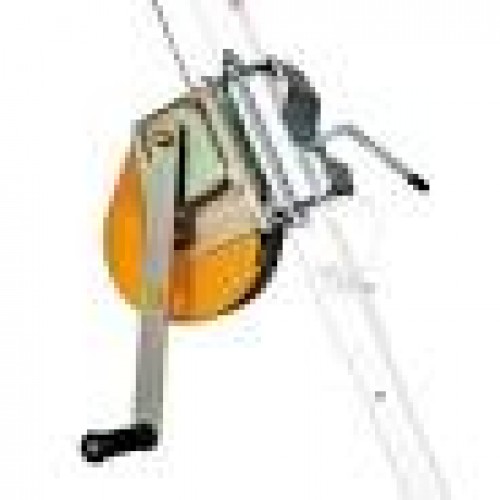
The RUP 502 is a lifting and lowering device with a handle for attaching a winch to the tripod leg.The winch is equipped with a six-stranded steel rope with a natural fiber core of 20 and 25 m in length and 6.3 mm in diameter.
RUP 502 is an element of rescue equipment.Using the device, an injured person can be raised from a lower level to a higher level or lowered from a higher level to a lower level.The lowering distance must not exceed 2 m. The gear used in the mechanism allows to perform one drum rotation per 5 turns of the winch crank.
The crank arm has 2 length options allowing the user to adjust the torque depending on the selected variant.The RUP 502 series evacuation device complies with the EN 1496/B norm.
Protekt RUP-502 Rescue Lifting Device
Product Description:
- 25M 6.3mm Steel Calganized Cable
- Automatic Brake
- Weight: 13KG
- Working Load: 180KG
- Breaking Force: 1800KG
- Standards: EN1496 Class B. Made in Poland
RUP 502 - Hand Lifting Device

Protection for maximum user's weight of 140 kg
Manhole Tripod
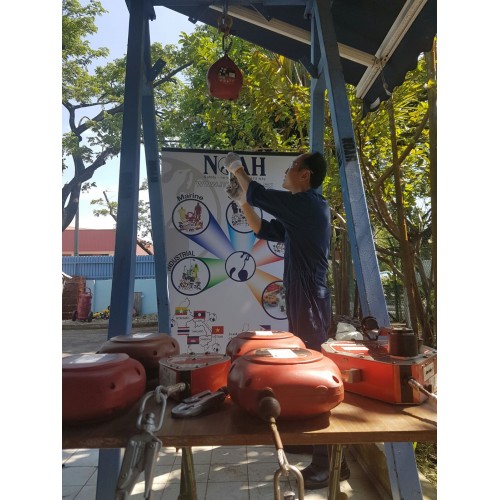
Confined Space Rescue - Tripod Winch
14.3 Emergency equipment requirement of IBC Code
14.3.1 Ships carrying cargoes, for which "Yes" is indicated in column n of chapter 17, shall be provided with suitable respiratory and eye protection sufficient for every person on board for emergency escape purposes, subject to the following:
- .1 filter-type respiratory protection is unacceptable;
- .2 self-contained breathing apparatus shall have at least a duration of service of 15 min;
- .3 emergency escape respiratory protection shall not be used for fire-fighting or cargo-handling purposes and shall be marked to that effect.
14.3.2 The ship shall have on board medical first-aid equipment, including oxygen resuscitation equipment and antidotes for cargoes to be carried, based on the guidelines developed by the Organization
14.3.3 A stretcher which is suitable for hoisting an injured person up from spaces such as the cargo pump-room shall be placed in a readily accessible location.
14.3.4 Suitably marked decontamination showers and an eyewash shall be available on deck in convenient locations. The showers and eyewash shall be operable in all ambient conditions.
Measures to Address the Revised Recommendations for Entering Enclosed Spaces Aboard Ships (MSC.581(110))
At the 110th session of the Maritime Safety Committee (MSC 110) held in June 2025, the Revised
Recommendations for Entering Enclosed Spaces Aboard Ships were adopted as IMO Resolution
MSC.581(110).
This resolution invited the Assembly to revoke resolution A.1050(27) and aims to prevent fatalities
and serious accidents related to enclosed space entry by clarifying requirements for definitions, risk
assessment, atmosphere testing, carbon dioxide (CO2) management, and emergency preparedness.
This Technical Information provides an overview of the main amendments and highlights important
points to be considered.
1. Outline
Resolution MSC.581(110) is a recommendatory instrument applicable to all ship types.
The resolution recommends that enclosed space entry should be managed within the Safety
Management System (SMS) of the Company.
The key focus areas include:
・ Treating enclosed spaces as unsafe until proven safe
・ Enhanced requirements for carbon dioxide (CO2) monitoring
・ Prohibition of single-person entry
・ Establishment of an Enclosed Space Register
・ Development of ship-specific emergency response plans
・ Strengthening of training and drills
2. Application
・ All ship types
・ All personnel who may enter enclosed spaces, including ship's crew, shore personnel, port
workers and ship operators.
3. Key Safety Requirements
3.1 Basic Principles for Enclosed Space Entry
・ All enclosed spaces should be considered unsafe for entry until declared safe (4.8)
・ Single-person entry is prohibited (3.11)
・ Entry should only be permitted following: (4.1)
- Completion of a risk assessment
- Issuance of an Enclosed Space Entry Permit
- Full-Body Harnesses: “A fall arrest kit or a fall recovery kit can include pre-packaged kit such as a harness - most often a full-body harness with leg loops, shoulder and chest straps.” It must feature multiple attachment points (D-rings on back and chest). [1]
- Shock-Absorbing Lanyards: Flexible connecting lines fitted with a built-in energy absorber. This mechanical device is critical to “absorbing energy and limiting the forces applied to the user's body” to safe levels during an arrest. [1, 2, 3, 4]
- Tripod and Winch Assembly: A lightweight, high-strength rescue tripod stand certified for man-riding and extraction operations. It must feature an integrated “rescue lifting/ lowering device (w/pulley)” and a high-tensile steel wire rope to hoist incapacitated crew members upward.
- Rescue Pole Kit: An extendable telescoping pole fitted with specialized catch hooks. This “enables the rescuer to remove a person from danger” remotely by capturing their harness D-ring without the rescuer having to step into the hazard zone. [1, 2]
- Hoisting Stretcher (Neil Robertson or Basket Type): A rigid, specialized stretcher kept in a “readily accessible location” that is legally required and specifically “suitable for hoisting an injured person from spaces below deck” (such as a cargo hold or pump room).
- Suspension Trauma Relief Straps: Small webbed foot-loops attached directly to the full-body harness. They allow a suspended conscious victim to stand up and relieve deadly venous blood pooling in the legs while waiting for the rescue team.
- Pre-use Inspection: All onboard safety lines, gear, and harnesses must undergo mandatory inspections by a competent crew member before every single deployment.
- Retirement Criteria: Any personal fall protection gear or rescue rope that has been subjected to the dynamic load of an actual fall or an operational accident must be permanently retired from service immediately
3.2 Enhanced Atmosphere Testing Requirements
All ships should carry at least two sets of gas detection equipment as required by SOLAS
regulation XI-1/7, Any ship which may carry a cargo capable of generating hazardous vapors
and which requires regular entry into the cargo space should carry two additional sets (7.3)
Based on the results of the risk assessment, the atmosphere should be tested using
calibrated instruments before entry and during entry: (7.4)
・ Oxygen content: 20.9%
・ Carbon dioxide (CO2): less than 0.5% (5,000 ppm)
・ Flammable gases or vapors: less than 1% of LFL (The assessment has determined that
there is potential for flammable gases or vapors)
・ Toxic gases: below 50% of applicable occupational exposure limits
3.3 Carbon Dioxide (CO2)
・ CO2 is a highly dangerous gas that may cause rapid unconsciousness and death (10.5.5)
・ Particular attention is required for spaces associated with bulk cargoes, organic cargoes,
or cargo residues (10.3)
3.4 Portable Gas Detectors
・ All personnel entering an enclosed space should be provided with portable gas
detectors (8.2)
・ Detectors should be capable of measuring oxygen (O2), carbon dioxide (CO2), flammable
gases/vapors, toxic gases (e.g. CO), and any other gases identified by the risk assessment
(8.2)
3.5 Enclosed Space Entry Permit
・ Entry should be conducted under an Enclosed Space Entry Permit (5.2)
・ The validity of the permit should not exceed 8 hours (5.2)
3.6 Enclosed Space Register
Each ship should maintain an Enclosed Space Register containing, as a minimum: (4.2)
・ Identification of enclosed spaces
・ Space-specific hazards
・ Ventilation and atmosphere testing methods
Information on connected or adjacent spaces
・ Emergency rescue equipment requirements
The register should be managed as part of the SMS and reviewed periodically.
3.7 Emergency Response and Training
・ A ship-specific enclosed space emergency response plan should be established and
incorporated into the SMS (11.1)
・ Rescue equipment should be readily available and maintained in usable condition (11.5)
・ Regular training and drills for enclosed space entry and rescue should be conducted
(3.8)
4. Incorporation into the Safety Management System (SMS)
Ship management companies are recommended to incorporate the following into their SMS in
accordance with MSC.581(110):
・ Enclosed space entry procedures
・ Risk assessment processes
・ Permit-to-work systems
・ Emergency response plans and Enclosed Space Register
・ Training, drills, and authorization
5. Notes
This Technical Information is intended to provide general guidance based on IMO Resolution
MSC.581(110)
For detailed requirements, reference should be made to the original IMO documents.
Please also refer to any instructions issued by the flag Administration, if applicable.
6. References
・ IMO Resolution MSC.581(110)
・ SOLAS Chapter XI-1 Regulation 7
・ SOLAS Chapter III Regulation 19.3.6
・ MSC.1/Circ.1477
Tripod System for Enclosed Space Rescue
590609 & 592151
FOR DECK DEPT |
RESCUE TRIPOD AND WINCH 铝合金三脚架加绞盘 ,密闭舱室救助使用 (见附图) |
密闭场所进入及救援
使用|船用救援三脚
架


