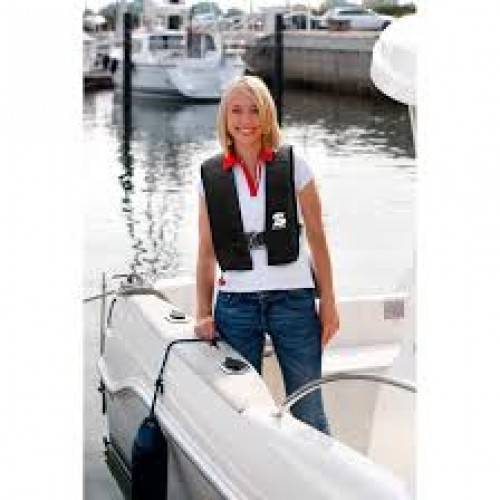
SECUMAR, MYSTIC, 15670, SINGLE 150N, INFLATABLE LIFEJACKET
ISO 12402 lifejacket
ISO 12402 Personal Flotation Devices
SECUMAR MYSTIC 150 Harness
(Automatic and Manual) Inflatable Lifejacket category 150 N
P/N: 15670
Buoyancy: approx. 165 N
Colour: Black
Weight: approx. 0.80 kg
CO2‐cartridge : 32 g CO2‐Cartridge (P/N 927)
Approvals : DIN EN ISO 12402‐3 DIN EN ISO 12401
Size : > 50 kg body weight 70 to 135 cm chest measurement
1. General Description/Application
Universal application, for inland waterways, in‐shore and off‐shore waters, shipyards.
This life jackets is equipped with an integrated safety harness.
2. Equipment Design and Function
The patented folding method of the ultra‐light lifejacket provides a comfortable fit. The neck is folded in such a
way as to allow complete freedom of movement for all activities. The lifejacket consists of a single buoyancy
chamber with a protective cover. When the lifejacket is inflated, the back strap adjusts automatically and ensures
an optimal fit. The life jacket is equipped with an integrated safety harness and stainless steel D‐ring. Available
with manual or fully automatic inflation device.
3. Features
Extremely light weight
The lifejacket fits snugly to the body, non‐bulky.
The lifejacket is easy to don with a front‐closing stainless steel buckle
covers DIN EN ISO 12402‐3
4. Technical Data:
Buoyancy chamber:
o polyurethane coated fabric, high frequency welded (HF)
o buoyancy approx. 165 N
o the buoyancy chamber is covered with 300 cm2 marine grade retro‐reflecting tape (3M®)
o color of buoyancy chamber: yellow
o fitted with an oral inflation tube and valve
Inflation system/gas:
o Fully automatic inflation device type SECUMATIC 3001 S (patented)
o designed with integrated manual release
o with indicator for thread depth/torque safe‐tying of CO2 cylinder
o activated by SECUMAR pill
o gas‐cylinder, contents 32 g CO2, easy to reload
Protective Stole
o integrated safety harness (acc. DIN EN ISO 12401)
o lifting becket (3.2 kN)
Material : Nylon fabric
Color : Black
Closed by : Velcro fastener
Buckle : stainless steel buckle
Straps:
o The lifejacket is adjusted by means of a waist and back strap.
o It is optionally equipped with an integrated safety harness.
Instructions for use/Labelling
o Each lifejacket is equipped with an instruction amd maintenance manual.
o The labelling is in accordance with DIN EN ISO 12402‐3.
5. Equipment
Whistle : Two‐tone‐whistle
Rescue strap : The lifejacket is equipped with a lifting becket (320 daN lifting capacity).
6. Parameters of use:
Temperature range:
o Storage : ‐54° C to +70° C
o Operation : ‐10° C to +70° C
The WSH Council has released new Guidelines on Personal Flotation Devices - Life Jackets (2025) to enhance safety for workers operating near water. These guidelines detail employer/worker responsibilities, proper selection based on environment (e.g., ISO 12402 standards), and best practices for maintenance, such as using certified equipment and proper storage.
Key Aspects of the New WSH Guidelines:
Purpose: To guide the selection, use, and maintenance of life jackets for workers at risk of drowning.
Key Content:
Selection: Recommends selecting appropriatecertified (ISO 12402 or SOLAS) life jackets based on the work environment (e.g., sheltered vs. non-sheltered waters).
Maintenance: Emphasizes regularpre-use inspections and storage in well-ventilated areas to prevent degradation.
Roles: Outlines responsibilities for employers to provide appropriate equipment and for workers to wear it.
Context: Launched in collaboration with the Maritime and Port Authority of Singapore (MPA) and the Ministry of Manpower (MOM).
An ISO 12402-3 life jacket is a safety standard for personal flotation devices that specifies the requirements for lifejackets of performance level 150. These lifejackets are intended for general, offshore, or rough water use for adults and children, and are designed to provide sufficient buoyancy and self-righting capabilities to keep the wearer's head above water. They meet safety and performance requirements for these general conditions, and are often required for commercial or recreational boating.
Key features and requirements
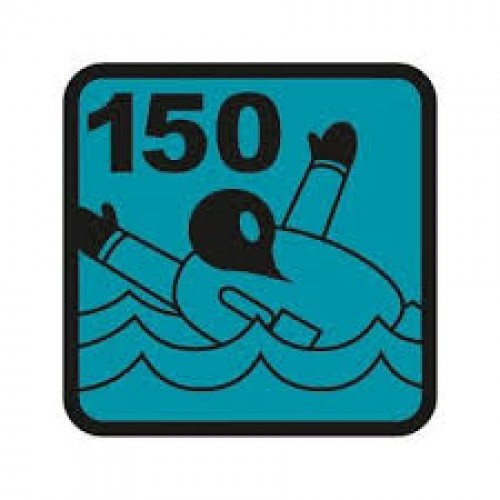
Performance level 150: This rating indicates the amount of buoyancy and self-righting capability the lifejacket provides.
General and offshore use: They are suitable for a range of conditions, including rough water, and are designed for general use in a maritime environment.
Suitable for adults and children: The standard applies to lifejackets for users of different ages.
Head support: A good design will provide a flotation collar to support the head and keep the airway clear.
Self-righting: A key function is the ability to turn an unconscious person face-up in the water to prevent drowning.
Safety: They meet the safety requirements set by the International Organization for Standardization (ISO).
Inflatables: Many ISO 12402-3 lifejackets are inflatable and may be activated manually or automatically.
Inflatable Work Vest
inflatable lifevest
(Automatic and Manual) Inflatable Lifejacket category 150 N
Buoyancy : approx. 165 N
Colour : Black
Weight : approx. 0.80 kg
CO2‐cartridge : 32 g CO2‐Cartridge (P/N 927)
Approvals : DIN EN ISO 12402‐3 DIN EN ISO 12401
Size : > 50 kg body weight 70 to 135 cm chest measurement
Features
Extremely light weight
The lifejacket fits snugly to the body, non‐bulky.
The lifejacket is easy to don with a front‐closing stainless steel buckle
covers DIN EN ISO 12402‐3
救生衣
Life Jackets
33 01 34
LJ-150NInflatable Life Jacket 150N Single Chamber
inflatable lifejacket single chamber with light (optional)
150N, INFLATABLE LIFEJACKET (meet ISO 12402 standard)
ISO 12402: INTERNATIONAL STANDARD FOR PERSONAL FLOTATION DEVICES (LIFEJACKETS AND BUOYANCY AIDS)
The ISO 12402 series for personal flotation devices (lifejackets and buoyancy aids) was prepared by the European Committee for Standardization (CEN) Technical Committee CEN/TC 162, Protective clothing including hand and arm protection and lifejackets, in collaboration with Technical Committee ISO/TC 188, Small craft, in accordance with the Agreement on technical cooperation between ISO and CEN (Vienna Agreement).
ISO 12402 consists of the following parts, under the general title Personal Flotation Devices (PFDs):
Part 2: Lifejackets, performance level 275 — Safety requirements
Part 3: Lifejackets, performance level 150 — Safety requirements
Part 4: Lifejackets, performance level 100 — Safety requirements
Part 5: Buoyancy aids (level 50) — Safety requirements
Part 6: Special purpose lifejackets and buoyancy aids — Safety requirements and additional test methods
Part 7: Materials and components — Safety requirements and test methods
Part 8: Accessories — Safety requirements and test methods
Part 9: Test methods
The International Organization for Standardization (ISO) is a worldwide federation of national standards bodies (ISO member bodies). The work of preparing International Standards is normally carried out through ISO technical committees. Each member body interested in a subject for which a technical committee has been established has the right to be represented on that committee. International organizations, governmental and non-governmental, in liaison with ISO, also take part in the work. ISO collaborates closely with the International Electrotechnical Commission (IEC) on all matters of electrotechnical standardization. International Standards are drafted in accordance with the rules given in the ISO/IEC Directives, Part 2.
NOAH is a ISO Certified (Lifejacket) Servicing Centre
Where the safety of peoples’ lives is concerned, regular inspection of the equipment concerned is absolutely essential. This also applies to lifejackets. Natural aging process can influence the properties of the material and also the functioning of the automatic inflator system is not immune to possible damage (among other things operational errors). In other words: the life of a lifejacket must be limited. The corresponding time frame has been set at 10 years, a decision borne authoritatively by the members of the German Association for Sea Rescue Equipment (FSR), and which complies with the law of safety and product liability.
A prerequisite for this lifetime is an inspection of the lifejacket by an authorized servicing station or the manufacturer at least every two years.
Safety as a visible sign
Regular inspection is documented by the FSR-Service-Sticker, which, similarly to a car’s MOT sticker, signalizes the month and year of the next service due.
Servicing
The regular system check by the expert comprises testing the buoyancy chamber for air leaks as well as a scrutinizing check of the fully automatic inflation system. Moreover, within the framework of this SERVICE we can offer:
Repair Removal of any defects discovered in the course of the inspection as well as replacement of the complete protective cover or buoyancy chamber.
Conversion / Optional extras Converting from manual release to automatic inflation, adding a spray hood, installation of an emergency light and further signalling accessories.
Receipt of the new FSR-Service-Sticker confirms, so to speak, the correct functioning of the rescue equipment and always reminds you of the Date of the next inspection, the sticker being clearly visible from the outside.
The table below
summarises the different performance levels of life jackets:





 The table below
summarises the different performance levels of life jackets:
The table below
summarises the different performance levels of life jackets:

