
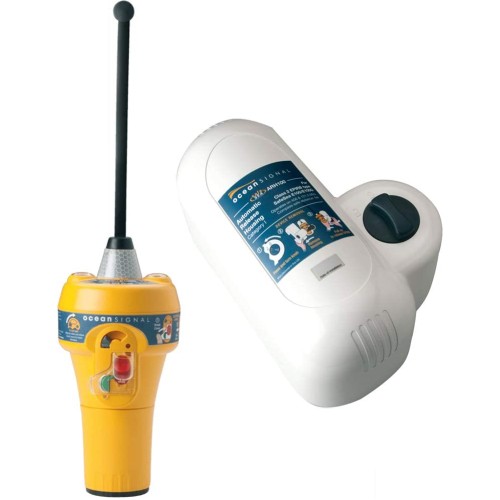
• OCEAN SIGNAL **EPIRB P/N: 700S-00766 Category 1 ARH100 Housing - Discontinued, see replacement below

OCEAN SIGNAL **EPIRB P/N: 700S-00766 Category 1 ARH100 Housing - Discontinued, see replacement below

  • Product Code: E100
  • Product SKU:
  • Item Code: GMDS-OSN-E100
  • Availability: In Stock

Discontinued, replaced by:

https://www.noah.com.sg/index.php?route=product/product&manufacturer_id=77&product_id=1897


OCEAN SIGNAL **EPIRB E100

P/N: 700S-00766 Category 1 ARH100 Housing

C/W MANUAL INCLUDE 4 X SCREWS/LABELS/1 X SOS CARD

EC-MED APPROVED TO SOLAS

ORIGIN: UK

The Ocean Signal SafeSea E100 (and E100G) is a 406 MHz COSPAS-SARSAT EPIRB designed for commercial, fishing, and leisure vessels, featuring high-endurance battery life and optional automatic deployment. The specific configuration mentioned (EPIRB Class II / SafeSea E100 with HR1E) refers to a unit designed for manual or automatic release, often with a 5-year battery replacement interval. 
Key Features of the Ocean Signal SafeSea E100:
  • Battery Life: Non-hazardous lithium battery with a 5-year replacement interval and over 96 hours of operational life, which is among the highest in the industry.
  • Performance: Operates on the 406MHz satellite band for global, rapid response, supplemented by a 121.5MHz homing beacon.
  • Strobe Light: Fitted with a high-brightness LED strobe light for night-time visibility.
  • Environmental: Designed for Class 2 (-20°C to +55°C) operation.
  • Class: Typically categorized as Class 2 (general use) or Class 1 (if used with ARH100 Auto Release Housing). 
Components:
  • SafeSea E100 EPIRB: The core distress beacon.
  • Hydrostatic Release Unit (HR1E): Specifically for the Auto Release Housing (ARH100), the HR1E (Part Number 701S-00608) triggers at a depth of 1.5 to 4 meters, allowing the EPIRB to float free and activate automatically.
  • Maintenance: The HR1E hydrostatic release unit must be replaced every two years. 


  • Choice of GPS and non-GPS models
    • E100G EPIRB incorporates a state of the art 50 channel GPS receiver for fast and accurate position acquisition
  • Manual bracket, manual release housing and float free housing options
  • Extreme battery life even at low temperatures
    • In excess of 96 hours operation
  • User replaceable batteries with five year replacement interval
  • Intuitive operating controls protected from accidental activation
  • Meets or exceeds all International standards
  • Class 2 EPIRB (-20°C – +55°C) for general use
  • Non hazardous battery

The SafeSea E100 & E100G EPIRBs have been designed and are engineered to meet the needs of all commercial, fishing and offshore recreational vessels

SafeSea EPIRBs operate in the 406MHz satellite band monitored by Cospas-Sarsat, the international satellite operator, ensuring a signal can be located wherever it is activated around the globe.

SafeSea EPIRBs are also fitted with a 121.5MHz homing beacon and a high brightness LED strobe light for fast on-scene location.

The SafeSea E100G EPIRB benefits from a dedicated built-in GPS which sends a highly accurate position, greatly reducing search time.

With the SafeSea EPIRB battery operating life being the highest in the industry an Ocean Signal EPIRB keeps rescue services updated with your location for longer.

https://www.mpa.gov.sg/web/portal/home/port-of-singapore/safety/search-rescue/emergency-position-indicating-radio-beacon-epirb

Emergency Position-Indicating Radio Beacon

The Emergency Position-Indicating Radio Beacon (EPIRB) allows vessels to be located quickly and accurately in times of distress. Singapore-registered ships must register their EPIRB with MPA.

Today's technology takes most of the 'search' out of search and rescue through the utilisation of satellites and modern radio distress beacons. Under the COSPAS-SARSAT international satellite-aided tracking system, polar orbiting satellites are able to detect distress signals from radio beacons.

Mariners call their beacons EPIRBs (Emergency Position Indicating Radio Beacons). An EPIRB is designed to float in water with its antenna pointing upright. and is required to operate for a minimum of 48 hours continuously once activated

The technology of distress beacons is so advanced that the location of the boat, aircraft or individual in distress can be calculated to a search area of around 20km with an analogue 121.5 MHz beacon and further reduced to a search area of as little as 110m with a digital 406 MHz beacon, if encoded with GPS.

The 406MHz beacon comes in two basic types: those that provide an encoded (GPS) location and those that do not. The satellite system can calculate a beacon’s location, but locating a distress site is usually much faster if the beacon signal provides a GPS location. Registration is free.

Note: 121.5 MHz distress beacons will no longer be detected by satellite from 1 February 2009. Older 121.5 MHz radio distress beacons, manufactured before 1990, were designed for detection by overflying aircraft, and not by satellite. These beacons are not compatible with the COSPAS-SARSAT system and should be replaced with a digital 406 MHz beacon.

Float-free EPIRBs are held in a bracket and fitted with a hydrostatic release that is water activated, deploying the beacon automatically if the vessel sinks. If the vessel continues to float, then the EPIRB can be manually deployed where a distress situation exists.

In a distress situation, it is important that once a beacon is switched on, you do not switch it off until rescue has been effected or you are advised to do so by the rescue authority.

Where a beacon has been activated inadvertently, the most important thing to do is:

  • Switch off the beacon to ensure that a search and rescue operation is not commenced. There is no penalty for inadvertent activations.
  • Notify the Port Operations Control Centre (POCC) in Singapore, which is the operational headquarters for a maritime SRR that covers both the island of Singapore and over 1 million square kilometres of the South China Sea (see Singapore SRR map).

24-hour emergency contact numbers

  • VHF Channel 16
  • VTIS working channels 7, 10, 14, and 73
  • Tel (+65) 6226 5539 or (+65) 6325 2493
  • Fax: (+65) 6227 9971
  • Telex: 20021

EPIRB registration

Always register your EPIRB.

This will help rescue forces find you more quickly in an emergency. The POCC maintains a database of EPIRBs fitted onboard Singapore-registered ships.

Owners or operators of all Singapore-registered ships must register their EPIRB with MPA by completing and submitting the EPIRB registration form.

If for some reason your beacon gets activated inadvertently, you will receive a call from the Coast Guard. This will avoid unnecessarily engaging SAR resources that may be needed in an actual emergency.

If inadvertent activation is discovered while at sea, the POCC must be informed by the most rapid means of communication, either direct or via another station with passing instructions to urgently forward to the POCC in Singapore.

Testing of EPIRBs should be done at regular intervals and in accordance with the manufacturer’s procedures. Batteries must also be kept in-date and fully charged.

Information about the COSPAS-SARSAT international satellite system can be found at http://www.cospas-sarsat.org.


SATELLITE EPIRB, 406MHZ/121.5MHZ 372511

整套EPIRB


Write a review

Note: HTML is not translated!
    Bad           Good
Captcha