
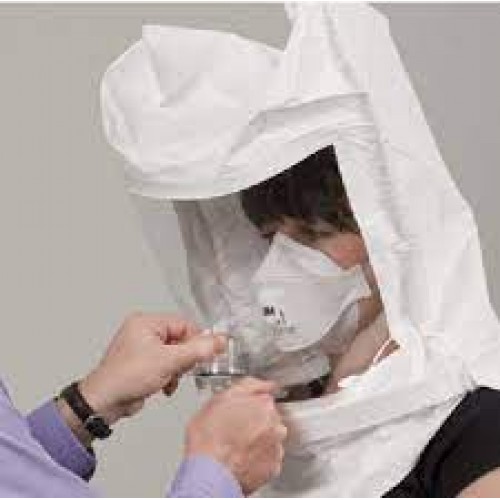




A qualitative fit test (QLFT) may only be used to fit-test:
- Negative-pressure, air-purifying respirators, as long as they’ll only be used in atmospheres where the hazard is at less than 10 times the permissible exposure limit (PEL).
- Tight-fitting facepieces used with powered and atmosphere-supplying respirators.
Each QLFT method uses seven exercises performed for 1 minute each:
- Normal breathing.
- Deep breathing.
- Moving head side to side.
- Moving head up and down.
- Bending over (or jogging in place if the fit test unit doesn’t permit bending at the waist).
- Talking.
- Normal breathing again.
OSHA requires qualitative or quantitative fit testing before a user wears a mandatory respirator on the job, and must be assessed at least annually. In addition, fit tests should be performed:
- whenever a different size, style, model or make of respirator is used, and
- when any facial changes occur that could affect fit, such as significant weight fluctuation or dental work.
Qualitative Fit Test (QLFT)
A qualitative fit test (QLFT) may only be used to fit-test:
- Negative-pressure, air-purifying respirators, as long as they’ll only be used in atmospheres where the hazard is at less than 10 times the permissible exposure limit (PEL).
- Tight-fitting facepieces used with powered and atmosphere-supplying respirators.
QLFT is pass/fail and relies on the user’s senses using one of four OSHA-accepted test agents:
- Isoamyl acetate (banana smell); only for testing respirators with organic vapor cartridges.
- Saccharin (sweet taste); can test respirators with a particulate filter of any class.
- Bitrex® (bitter taste); can also test respirators with particulate filters of any class.
- Irritant smoke (involuntary cough reflex); only for testing respirators with level 100 particulate filters.
Each QLFT method uses seven exercises performed for 1 minute each:
- Normal breathing.
- Deep breathing.
- Turning head side to side.
- Moving head up and down.
- Talking.
- Bending over (or jogging in place if fit test unit doesn’t permit bending at the waist).
- Normal breathing again.


