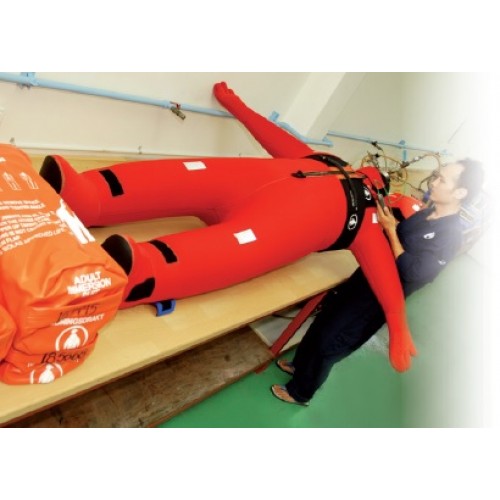
SERVICE - PRESSURE TEST - IMMERSION SUIT
immersion suit pressure test
For service booking contact:
T: (+65) 6266-0788 | E: service2@noah.com.sg | W: www.noah.com.sg
IMMERSION SUITS - INSPECTION, MAINTENANCE & CERTIFICATION
Immersion suits to be inspected regularly and air pressure tested every 3 years
Ref. T4/3.01 MSC/Circ.1114
25 May 2004
GUIDELINES FOR PERIODIC TESTING OF IMMERSION SUIT AND
ANTI-EXPOSURE SUIT SEAMS AND CLOSURES
1 The Maritime Safety Committee, at its seventy-eighth session (12 to 21 May 2004),
recognizing that shipboard inspections of immersion suits and anti-exposure suits carried out in
accordance with SOLAS regulation III/20.7 and MSC/Circ.1047 may not be adequate to detect
deterioration of seams and closures of the suits due to adhesive ageing, and having considered the
recommendation made by the Sub-Committee on Ship Design and Equipment at its forty-sixth
session, approved the Guidelines for periodic testing of immersion suit and anti-exposure suit seams
and closures, as set out in the annex.
2 Member Governments are invited to bring the annexed Guidelines to the attention of all
parties concerned.
MSC/Circ.1114
I:\CIRC\MSC\1114.DOC
ANNEX
GUIDELINES FOR PERIODIC TESTING OF IMMERSION SUIT AND
ANTI-EXPOSURE SUIT SEAMS AND CLOSURES
1 Research performed by several Member Governments has demonstrated that the seams and
closures of immersion suits and anti-exposure suits experience deterioration over time. The rate and
severity of deterioration may vary widely, depending upon the specific components and procedures
employed in the manufacture of the suit and the conditions under which the suit is stored. However,
even under ideal conditions, the materials and adhesives used have a finite service life and will
inevitably experience a reduction in strength and/or loss of watertightness with age.
2 The Guidelines for monthly shipboard inspection of immersion suits and anti-exposure suits
(MSC/Circ.1047) are very helpful in identifying obvious problems with a suit, but do not adequately
address deterioration of seams and closures (zippers, etc.) which may not be readily apparent by
visual inspection. Such deterioration can be detected by pressurization of the suit with air, and
testing of the seams and closures for leaks with a soapy water solution.
3 To ensure the maintenance of adequate strength and watertightness of seams and closures of
immersion suits and anti-exposure suits with age, it is recommended that each suit be subjected to an
air pressure test such as the following, at intervals not exceeding three years, or more frequently for
suits over ten years of age:
.1 A suitable head piece, fitted with a means to inject air into the suit, should be inserted
into the face orifice of the suit and secured so as to minimize leakage around the face
seal. A low-pressure monitoring device, either integral to the fitting for air injection
or as a separate device, should also be inserted. If the suit is fitted with detachable
gloves and/or boots, the wrists and/or cuffs should be sealed by inserting a short
length of suitable diameter plastic pipe and securing the gloves and/or boots with
suitable wire ties or hose clamps. The zipper should be fully zipped, and any face
flap closed. The suit should then be inflated to a pressure of 0.7 to 1.4 kPa (0.1 to
0.2 psi). If an auxiliary inflatable means of buoyancy is provided, it should be
inflated through the oral valve to a pressure of 0.7 kPa (0.1 psi) or until firm to the
touch.
.2 Each seam and closure of the suit - and each seam, oral tube and attachment points
and joint or valve of any auxiliary inflatable means of buoyancy - should then be
covered with a soapy water solution containing enough soap to produce bubbles (if
leakage is noted at a foot valve to the extent that air pressure cannot be maintained,
the valves should be sealed for the test).
.3 If leaks are revealed by the propagation of bubbles at seams or closures, the leaking
areas should be marked and, after cleaning the suit thoroughly with fresh water and
drying it, repaired in accordance with the suit manufacturer's recommendations.
MSC/Circ.1114
ANNEX
Page 2
I:\CIRC\MSC\1114.DOC
4 It is recommended that the air pressure test be performed at a suitable shore-based facility
equipped to make any necessary repairs in accordance with the manufacturer's recommendations. In
view of the wide variety of materials and adhesives used in immersion suits and anti-exposure suits,
it is strongly recommended that any repairs to a suit be carried out by a facility which has access to
the original manufacturer's recommended servicing instructions, parts and adhesives, and suitably
trained personnel. The air pressure test may be carried out on board ship if suitable equipment is
available.
__________
PERIODIC TESTING OF IMMERSION SUIT AND ANTI-EXPOSURE SUIT SEAMS AND CLOSURES (MSC/Circ.1114)
Shipping Circulars
No. 12 of 2009
03 Mar 2009
Applicable to:Shipowners, masters and officers of Singapore ships
This circular is to inform shipowners, masters and officers of Singapore ships of the need for the periodic testing of immersion suit and anti-exposure suit seams and closures in accordance with the guidelines set out in MSC/Circ.1114 dated 25 May 2004.
PERIODIC TESTING OF IMMERSION SUIT AND ANTI-EXPOSURE SUIT SEAMS AND CLOSURES (MSC/Circ.1114)
Research performed by several maritime Administrations has demonstrated that the seams and closures of immersion suits and anti-exposure suits experience deterioration over time.The rate and severity of deterioration may vary widely, depending upon the specific components and procedures employed in the manufacture of the suit and the conditions under which the suit is stored.However, even under ideal conditions, the materials and adhesives used have a finite service life and will inevitably experience a reduction in strength and/or loss of watertightness with age.
2.Monthly inspection of immersion suits and anti-exposure suits carried out in accordance with SOLAS regulation III/20.7 (see Shipping Circular MC No. 16 of 2002 dated 4 September 2002) may not be adequate to detect deterioration of seams and closures of the suits due to adhesive ageing and do not adequately address deterioration of seams and closures (zippers, etc.) which may not be readily apparent by visual inspection. Such deterioration can be detected by pressurization of the suit with air, and testing of the seams and closures for leaks with a soapy water solution.
3.To ensure the maintenance of adequate strength and watertightness of seams and closures of immersion suits and anti-exposure suits with age, each suit should be subjected to an air pressure test at intervals not exceeding three years, or more frequently for suits over ten years of age in accordance with the guidelines set out in IMO Circular MSC/Circ.1114 dated 25 May 2004 as part of the maintenance required to be carried out by SOLAS Reg III/20.3.1. A copy of the circular can be found in our website under "Circulars & Notices > Shipping Notices" at:http://www.mpa.gov.sg/web/wcm/myconnect/www/b36f16e4-4b43-4a85-8ddd-0b25d7146aed/circ1114.pdf?MOD=AJPERES
4.Notwithstanding that paragraph 4 of MSC/Circ.1114 recommends that the air pressure test be performed at a suitable shore-based facility, periodic testing of immersion suits and anti-exposure suits may be carried out by shipboard personnel who are deemed to have the necessary skills, knowledge and competence to carry out the test in accordance with MSC/Circ.1114 and with instructions provided by the manufacturer and that there are available on board suitable equipment necessary to carry out the test.
5.The "Company" as defined in paragraph 1.1.2 of the ISM Code may assess and decide on the shipboard personnel deemed to have the necessary skills, knowledge and competence to carry out the test in accordance with MSC/Circ.1114.
Carriage Requirements
- SOLAS Chap.III/7.3;
An immersions suit or anti-exposure suit of an appropriate size shall be provided for every person assigned to crew the rescue boat or assigned to the marine evacuation system party.
- SOLAS Chap.III/32.3
- The paragraph applies to all cargo ships.
- An immersion suit of an appropriate size shall be provided for every person on board the ship. However, for ships other than bulk carriers, as defined in Chap.IX/1, these immersion suits need not be required if the ship in constantly engaged on voyages in warm climates where, in the opinion of the Administration, immersion suits are unnecessary.
- If a ship has any watch or work stations which are located remotely from the place or places where immersion suits are normally stowed, including remotely located survival craft carried in accordance with Chap.III/31.1.4 additional immersion suits of an appropriate size shall be provided at these locations for the number of persons normally on watch or working at those locations at any time.
(supplement) At least two sets of immersion suits are to be provided for the stored position of the additional liferaft required by Chap.III/31.1.4 (IACS UI SC213 Rev.4). - Immersion suits shall be so placed as to be readily accessible and their position shall be plainly indicated.
- The immersion suits required by this regulation may be used to comply with the requirements of Chap.III/7.3.
Reference: https://www.classnk.or.jp/hp/en/activities/statutory/solas/solas_treaty/immersion/
Immersion suits/Anti-exposure suits - Flag Information
Please see the instructions from the flag states for immersion suits and anti-exposure suits required by SOLAS Chap.III/20.7 and 32.3. And please confirm the below hereafter as ClassNK Technical Information related to the subject had been voided.
Carriage Requirements
- SOLAS Chap.III/7.3;
An immersions suit or anti-exposure suit of an appropriate size shall be provided for every person assigned to crew the rescue boat or assigned to the marine evacuation system party.
- SOLAS Chap.III/32.3
- The paragraph applies to all cargo ships.
- An immersion suit of an appropriate size shall be provided for every person on board the ship. However, for ships other than bulk carriers, as defined in Chap.IX/1, these immersion suits need not be required if the ship in constantly engaged on voyages in warm climates where, in the opinion of the Administration, immersion suits are unnecessary.
- If a ship has any watch or work stations which are located remotely from the place or places where immersion suits are normally stowed, including remotely located survival craft carried in accordance with Chap.III/31.1.4 additional immersion suits of an appropriate size shall be provided at these locations for the number of persons normally on watch or working at those locations at any time.
(supplement) At least two sets of immersion suits are to be provided for the stored position of the additional liferaft required by Chap.III/31.1.4 (IACS UI SC213 Rev.4). - Immersion suits shall be so placed as to be readily accessible and their position shall be plainly indicated.
- The immersion suits required by this regulation may be used to comply with the requirements of Chap.III/7.3.
- Instructions from Flag State Administrations
Air pressure test and Monthly inspection