
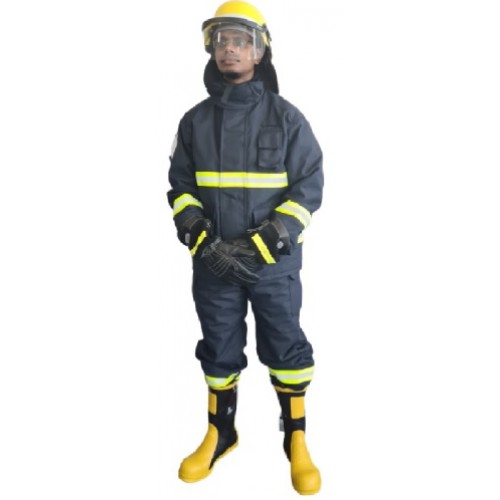


RS, FIREMAN SUIT NOMEX, COMPLETE, SOLAS/EN469
- Product Code: FIREMAN SUIT fireman's suit x2 y2 z2
- Product SKU:
- Item Code: PICK-RSG-FSUIT-03
- Availability: In Stock
Jiaxing Rongsheng Lifesaving Equipment Co., Ltd
RS, FIREMAN SUIT NOMEX, COMPLETE, SOLAS/EN469
fire fighting suit singapore
(Part of fireman's outfit solas requirements)
FIREMAN SUIT NOMEX, COMPLETE, C/W: SOLAS/EN469
a) Jacket + Trousers, BLUE, RSZD-F, Size: L
b) Helmet 2MZP
c) 5-Fingers Gloves 2MZO
d) Etche Fireman's Boots
e) Carrying Bag
The Complete SOLAS Fireman’s Outfit offers unparalleled protection and performance for professional firefighters. Its SOLAS certification ensures that it meets the highest international standards for marine firefighting, making it the perfect choice for firefighters working on ships and other marine vessels. Additionally, its advanced materials and construction provide superior comfort and durability, allowing firefighters to focus on the task at hand without worrying about their equipment.
Marine Fireman's Outfit IMPA 330917 / 330923 / 330924 / 330925
FIREMAN'S SUIT COMPLETE SET, ARAMID FIBRES, NON- ALUMINIUM, SOLAS APPROVED, WITH CERTIFICATE
The Fireman Suit is a two-piece garment with a four - layer construction.
The outer shell is Nomex one type of Meta aramid.
The second layer is a waterproof breathable membrane.
The third layer is an meta-aramid/para-aramid felted thermal barrier and the fourth layer is a aramid lining.
The jacket has a stand up collar, elasticated cuffs, and is closed by a zip covered by an overlapping front with touch and close fastening to the front and collar.
The trousers have wide
elastic braces with adjusters and quick-release
buckles
Effective from June 04th, 2025, the implementation of the new MED directive (EU) 2022/1157 mandates that all newly acquired firefighter suits for onboard deployment must adhere to the EN469:2020 specifications. Consequently, firefighter suits manufactured in compliance with the preceding EN469:2005 standard will no longer be permissible for placement aboard any vessel beyond this date.While fire-fighting equipment including fire suits, has always been under scrutiny by Port State Control officers, the Flag Administrations and Classification Societies have requested an increased attention of the Port State Control officers to the Fire Suits on board the vessels. Background:
According to the standards there are three criteria that classify the Fire
Suits as level 1 or 2, e.g. (Y1) or (Y2):
Thermal Performance (X)
Water
Penetration Resistance (Y)
Breathability/Water
Vapor Resistance (Z)

Regulation on
fire-fighter’s suits:
Regulations
require that the vessels are equipped with water-resistant fire-fighter’s
suits or Y2 grade
suits (X2Y2Z2).
X2Y2Z2
is requested by PSC officers in case the suit is used in enclosed areas where
the fire-fighter will definitely be wet and with a X2Y2 suit he/she will be
protected against steam scalding.
Tier 1 HRI Firefighting Suit
fire fighter suit
BUNKER SUIT/ BUNKER GEAR
bunker gear
bunker suits for firefighters
fire fighting bunker gear
EN469 standard Firemans outfit
EN 469:2020
Protective clothing for firefighters - Performance requirements for protective clothing for firefighting activities
The EN 469:2020 standard specifies performance requirement levels for firefighters’ protective clothing. The standard's pictogram summarizes three key values: X (protection against flame and radiant heat), Y (water resistance of the product), and Z (breathability).
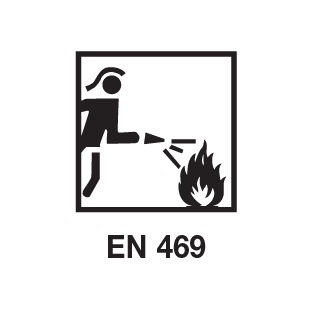
The EN 469:2020 standard specifies performance requirement levels for firefighters’ protective clothing. The standard's pictogram summarizes three key values: X (protection against flame and radiant heat), Y (water resistance of the product), and Z (breathability).
Flame (Xf)
The EN ISO 9151 test method (flame test) involves heat transmission (flame) with a heat flux of 80 kW/m2.
Related Products
RS, FIREMAN SUIT NOMEX, COMPLETE, SOLAS/EN469
RS, FIREMAN SUIT NOMEX, COMPLETE, SOLAS/EN469 fire fighting suit singapore(Part of fireman's ou..
The EN ISO 9151 test method (flame test) involves heat transmission (flame) with a heat flux of 80 kW/m2.
Related Products
RS, FIREMAN SUIT NOMEX, COMPLETE, SOLAS/EN469
RS, FIREMAN SUIT NOMEX, COMPLETE, SOLAS/EN469 fire fighting suit singapore(Part of fireman's ou..


