
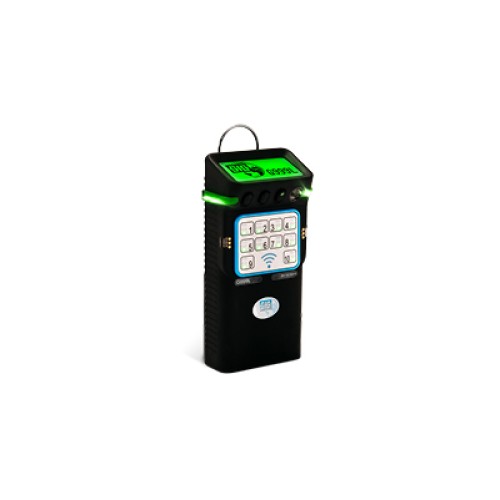
GFG G999M detector WITH NiMH BATTERY PACK AND INTERNAL PUMP - O2/LEL/CO/H2S/CO2 (Carbon Dioxide)
- Product Code: G999M - CO2-GAS-MONITORING-EQUIPMENT
- Product SKU:
- Item Code: GDTR-GFG-G999M
- Availability: In Stock
5 in 1 Gas Detector Comply IMO MSC.581(110)
5-in-1 gas detectors complying with the latest MSC.581(110) regulations
Model: G999M with NiMH battery pack and
internal pump
With the following sensors:
O2, Range 0
to 25 Vol%
CH4,Range 0
to 100 % LEL
CO, Range 0
to 500 ppm
H2S, Range 0
to 100 ppm
IR CO2 ,
Range 0 to 5 Vol%
Drop-in charger DIC 888/999 with EU plug-in charger
MADE IN GERMANY
The beauty of our G999M is that a user only requires one device to perform both
personal continuous monitoring (diffusion mode) and active pre-entry clearance measurement (pump mode)
船用5合一气体探测仪
CO2,CO,H2S,O2,CH4
CO2 GAS MONITORING EQUIPMENT
Polytector III G999M
The Polytector III G999M combines the requirements of a modern multi-gas detector for personal use in mining and in Ex zone 0 with the ability to clear confined spaces, shafts and vessels by means of an integrated pump. The robust and practical multi-gas detector is equipped with a catalytic combustion sensor for combustible gases, an infrared sensor for CO2 and 3 electrochemical sensors for toxic gases as well as oxygen. In this configuration, the G999M is versatile in use and reliably detects all potentially dangerous gases and vapors underground.
The Polytector III G999M is the best choice for personal protection against a wide range of gas dangers in mining and in Ex-Zone 0 and clearance before entering shafts and confined spaces. The multi-gas detector is equipped with 5 sensors for the detection of up to 7 combustible and toxic gases as well as oxygen. Clearance measurement is done with the integrated pump.
Safety and operation
The Polytector III G999M is certified for use up to Ex zone 0 and protected against the ingress of water and dust according to protection class IP67, making the multi-gas detector suitable for challenging applications. The housing made of rubberized polycarbonate offers excellent protection against shocks and vibrations. Its effective design and the robust crocodile clip ensure high wearing comfort. The G999C is operated via three buttons and the color-backlit display. For better usability, the screen can be rotated by 180 degrees if required, and an explosion-proof flashlight will solve any problems with poor light conditions.
Alarm, battery life and pump performance
If a threshold value is exceeded, the G999M will warn its wearer in three ways: via light signals, vibration and a loud horn (103 db(A)). The integrated NiMH battery has a runtime of up to 130 hours, depending on the operating mode and sensor configuration. The metering pump delivers around 0.6 liters per minute from a distance of up to 100 meters.
Accessories
The DS400/404 docking station can be used to charge, calibrate and adjust the gas detectors of the G999 series. To better distinguish gas detection devices for different applications, they can be marked with diffusion covers in five signal colors. Clearance measurement is made easier with various suction tubes and floating probes. A complete overview of the accessories and all extensions offered for the G999 series can be found at the bottom of this page.
Model variants
There are four other models available in the G999 series: the G999C, G999S, G999P and G999M. All of these detectors offer slots for 3 electrochemical and an optional (combination) infrared sensor. Depending on the model variant, G999s also come with a catalytic sensor (G999C & G999M), a PID sensor (G999P), a fourth electrochemical sensor (G999E) or a CC/TC or CC/TC/SC sensor (G999S). This allows you to set up a variety of combinations of up to eight gases or measuring ranges for simultaneous monitoring. The G999M, which was developed specifically for the mining sector, is not only approved for use in Ex zone 0 but also received the M1 label for safe use underground. If you require a multi-gas detector without an integrated pump, the handy Microtector G888 is a great choice. It comes in two different versions: the G888C for use in Ex zone 1 and the G888M, which can be used in Ex zone 0 and is approved for mining applications. Both models feature slots for up to 5 sensors (3x EC, 1x CC, 1x IR).
Downloads
- Battery: An integrated NiMH battery provides an operating time of up to 130 hours, depending on the specific operating mode and sensor configuration.
- Pump: The internal metering pump can sample approximately 0.6 liters per minute from a distance of up to 100 meters. This makes it suitable for clearance measurements before entering potentially hazardous areas.
- Detection: It can detect up to seven different gases simultaneously using various sensor combinations to warn users of toxic, flammable gases/vapors, and oxygen deficiency or excess.
- Alarms: The device warns its wearer in three ways when a threshold is exceeded: visual light signals, vibration, and a loud 103 dB(A) horn.
- Durability: The housing is made of rubberized polycarbonate, providing excellent protection against shocks and vibrations, and is certified as IP67 for dust and water protection.
- Mandatory Parameters: Standard 4-gas detectors (O₂, LEL, CO, H₂S) are no longer sufficient. You must now test for Carbon Dioxide (CO₂) alongside oxygen, flammable gases, and toxic gases.
- Pre-Entry Threshold Limits:
- Oxygen (O₂): ≥ 20.9%
- Carbon Dioxide (CO₂): < 0.5% (5,000 ppm)
- Flammable Gases (LEL): < 1%
- Toxic Gases: < 50% of the Occupational Exposure Limit (OEL) [
- Technology Standard: CO₂ measurement requires Non-Dispersive Infrared (NDIR) sensor technology to detect low-level ppm and asphyxiation risks (such as damp iron oxygen depletion).
- Quantity on Board:
- Standard vessels: At least 2 sets of portable gas detection equipment.
- High-risk cargo vessels (e.g., carrying coal, wood pellets, metal sulfide concentrates, or vapor-generating cargoes): At least 4 sets.
- Remote Sampling: Instruments must include pumps, flexible hoses, or fixed sampling lines to test distant or unventilated areas safely before entry.
- Personal Monitors: Every entering crew member should carry a calibrated personal gas detector for continuous individual monitoring rather than relying solely on a single pre-entry test
A multi-gas detector for O2/LEL/CO/H2S/CO2 is a portable safety device that simultaneously monitors five critical gases: Oxygen (O2 - deficiency/enrichment), Lower Explosive Limit (LEL - flammable gases like methane), Carbon Monoxide (CO - toxic), Hydrogen Sulfide (H2S - toxic/flammable), and Carbon Dioxide (CO2 - asphyxiant), providing real-time readings and alarms (sound/light/vibration) for hazardous environments like confined spaces, oil & gas, and mining to prevent accidents.
Key Gases Detected & Their Risks:
Oxygen (O2): Detects dangerous O2 levels, preventing asphyxiation (low O2) or fire/explosion risks (high O2).
Lower Explosive Limit (LEL): Measures flammable gases (like methane, propane) to warn of explosion hazards, often showing % of the LEL.
Carbon Monoxide (CO): A highly toxic, odorless gas from incomplete combustion, posing severe health risks.
Hydrogen Sulfide (H2S): A poisonous gas with a "rotten egg" smell that can quickly become deadly, common in sewers/refineries.
Carbon Dioxide (CO2): An asphyxiant, especially in confined spaces, that displaces oxygen.
Features & Use:
Portable & Wearable: Often clip-on designs for hands-free monitoring.
Real-Time Data: Large LCD displays readings for all gases simultaneously.
Alarms: Audible, visual, and vibrating alerts for immediate danger.
Applications: Ideal for confined space entry (tunnels, tanks), emergency response, and industrial sites (oil, chemical, mining).
Measures to Address the Revised Recommendations for Entering
Enclosed Spaces Aboard Ships (MSC.581(110))
At the 110th session of the Maritime Safety Committee (MSC 110) held in June 2025, the Revised
Recommendations for Entering Enclosed Spaces Aboard Ships were adopted as IMO Resolution
MSC.581(110).
This resolution invited the Assembly to revoke resolution A.1050(27) and aims to prevent fatalities
and serious accidents related to enclosed space entry by clarifying requirements for definitions, risk
assessment, atmosphere testing, carbon dioxide (CO2) management, and emergency preparedness.
This Technical Information provides an overview of the main amendments and highlights important
points to be considered.
1. Outline
Resolution MSC.581(110) is a recommendatory instrument applicable to all ship types.
The resolution recommends that enclosed space entry should be managed within the Safety
Management System (SMS) of the Company.
The key focus areas include:
・ Treating enclosed spaces as unsafe until proven safe
・ Enhanced requirements for carbon dioxide (CO2) monitoring
・ Prohibition of single-person entry
・ Establishment of an Enclosed Space Register
・ Development of ship-specific emergency response plans
・ Strengthening of training and drills
2. Application
・ All ship types
・ All personnel who may enter enclosed spaces, including ship's crew, shore personnel, port
workers and ship operators.
3. Key Safety Requirements
3.1 Basic Principles for Enclosed Space Entry
・ All enclosed spaces should be considered unsafe for entry until declared safe (4.8)
・ Single-person entry is prohibited (3.11)
・ Entry should only be permitted following: (4.1)
- Completion of a risk assessment
- Issuance of an Enclosed Space Entry Permit
3.2 Enhanced Atmosphere Testing Requirements
All ships should carry at least two sets of gas detection equipment as required by SOLAS
regulation XI-1/7, Any ship which may carry a cargo capable of generating hazardous vapors
and which requires regular entry into the cargo space should carry two additional sets (7.3)
Based on the results of the risk assessment, the atmosphere should be tested using
calibrated instruments before entry and during entry: (7.4)
・ Oxygen content: 20.9%
・ Carbon dioxide (CO2): less than 0.5% (5,000 ppm)
・ Flammable gases or vapors: less than 1% of LFL (The assessment has determined that
there is potential for flammable gases or vapors)
・ Toxic gases: below 50% of applicable occupational exposure limits
3.3 Carbon Dioxide (CO2)
・ CO2 is a highly dangerous gas that may cause rapid unconsciousness and death (10.5.5)
・ Particular attention is required for spaces associated with bulk cargoes, organic cargoes,
or cargo residues (10.3)
3.4 Portable Gas Detectors
・ All personnel entering an enclosed space should be provided with portable gas
detectors (8.2)
・ Detectors should be capable of measuring oxygen (O2), carbon dioxide (CO2), flammable
gases/vapors, toxic gases (e.g. CO), and any other gases identified by the risk assessment
(8.2)
3.5 Enclosed Space Entry Permit
・ Entry should be conducted under an Enclosed Space Entry Permit (5.2)
・ The validity of the permit should not exceed 8 hours (5.2)
3.6 Enclosed Space Register
Each ship should maintain an Enclosed Space Register containing, as a minimum: (4.2)
・ Identification of enclosed spaces
・ Space-specific hazards
・ Ventilation and atmosphere testing methods
Information on connected or adjacent spaces
・ Emergency rescue equipment requirements
The register should be managed as part of the SMS and reviewed periodically.
3.7 Emergency Response and Training
・ A ship-specific enclosed space emergency response plan should be established and
incorporated into the SMS (11.1)
・ Rescue equipment should be readily available and maintained in usable condition (11.5)
・ Regular training and drills for enclosed space entry and rescue should be conducted
(3.8)
4. Incorporation into the Safety Management System (SMS)
Ship management companies are recommended to incorporate the following into their SMS in
accordance with MSC.581(110):
・ Enclosed space entry procedures
・ Risk assessment processes
・ Permit-to-work systems
・ Emergency response plans and Enclosed Space Register
・ Training, drills, and authorization
5. Notes&l


