

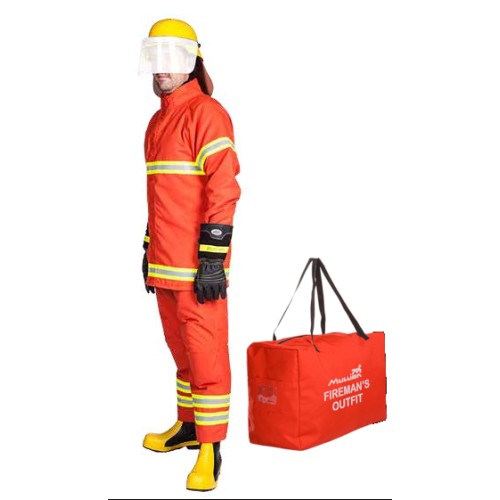



IMPA 330901 FIREMAN'S SUITS MULLION FIRE FIGHTER, COMPLETE, C/W: SOLAS / EN469 SIZE: XL
- Product Code: FIREMAN SUIT-XL
- Product SKU:
- Item Code: PICK-MUL-FSUIT-06
- Availability: In Stock
330912 FIREMAN'S COAT UNLINED
IMPA Code:
330912
UOM:
PCS
MTML UOM:
PCE
Required according to SOLAS regulations Chapter II Regulation 17. “All ships shall carry at least two fireman’s outfits complying with the requirements.” In addition, two fireman’s outfits shall be provided for tankers. One set contains Protective clothing, Boots, Gloves, Helmets, Electric safety lamp and Axe. However, Electrical safety lamp and Axe are not included in the unit.
MULLION FIRE FIGHTER, COMPLETE, C/W: SOLAS / EN469 SIZE: XL
MULLION FIREMAN SUIT, COMPLETE
C/W: JACKET, TROUSERS, ORANGE (EN469),
PAB FIRE COMPACT FIREMAN HELMET, YELLOW/WHITE, GLOVES 2MZO RESCUE2 (EN659), BOOTS, ETCHE, FIREMAN SABF BOOTS (EN 15090:2012, EN ISO 20345 S5) & CARRYING BAG EC-MED APPROVED TO SOLAS, EN 469 2020
(Part of fireman's outfit solas requirements)
FIRE FIGHTING SUIT, MULLION, FIRE FIGHTER
INTERVENTION JACKET & TROUSERS WITH SUSPENDERS,
531(1MMF & 1MPF), COLOUR: ORANGE, TWO‐LAYER
ARAMID (NOMEX) THERMAL INSULATION BARRIER, C/W:
CARRYING BAG
DOUBLE CERTIFICATION: EN469 AND SOLAS
MADE IN BELGIUM
Features:
- Professional fire fighter complete suit that complies to SOLAS/MED regulations
Specifications:
- Fireman Intervention Jacket & Trousers, 531(1MI9)
- Fireman Helmet, H1000 (2MZP)
- Fireman 5-Finger Gloves, (2MZO)
- Fireman Boots, 9687L (2MZN)
- Fireman Carrying Bag, (139Z)
Applications:
- Offshore Facilities
- Supply / Commercial Vessels
- Bulk Carriers
- Oil And LPG Tankers
- Container And Load Vessels That Operate In Cold Water
Certifications / Safety Approvals:
- SOLAS
- EN 469 : 2020
Mullion is a brand and division of Sioen Apparel, which is part of the Sioen Industries Group.- Role: Mullion specializes in high-quality professional protective maritime clothing, including personal floatation devices (PFDs), lifejackets, and immersion suits.
- Context: It is a key brand within Sioen’s marine safety portfolio, often working alongside sister brand Ursuit to provide safety gear for extreme working environments like offshore oil rigs and fishing industries.
- Company Structure: Sioen Apparel is one of three divisions of Sioen Industries (along with Sioen Coating and Sioen Chemicals).
A fireman's outfit marked with Xf2, Xr2, Y2, and Z2 refers to a Level 2 protective suit under the EN 469 standard. This classification indicates the highest level of protection, specifically required for structural firefighting and high-risk enclosed spaces like ships.The specific markings stand for:- Xf2 / Xr2: Resistance to convective heat (Xf) and radiant heat (Xr) at the highest performance level (Level 2).
- Y2: Resistance to water penetration, which includes a mandatory moisture barrier for protection against steam and chemicals.
- Z2: Water vapor resistance (breathability), ensuring the garment can effectively manage heat stress for the wearer.
As of 2026, European maritime regulations require that shipboard firefighting suits be upgraded to this Level 2 standard for enhanced safety in hazardous environments.Structural Firefighting Gear (EN 469 Level 2)
EN 469:2020
Protective clothing for firefighters - Performance requirements for protective clothing for firefighting activities
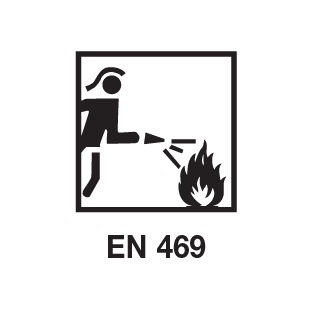
The EN 469:2020 standard specifies performance requirement levels for firefighters’ protective clothing. The standard's pictogram summarizes three key values: X (protection against flame and radiant heat), Y (water resistance of the product), and Z (breathability).
Protective clothing for firefighters - Performance requirements for protective clothing for firefighting activities
This document specifies minimum performance requirements for protective clothing designed to be worn during firefighting activities. The requirements detailed in this document cover design, heat and flame, mechanical, chemical, comfort, and visibility.
This document covers the general clothing design, the minimum performance levels of the material used, the methods of test to be used to determine these performance levels, marking and information supplied by the manufacturer.
This document makes distinction between firefighting activities dividing them into two performance levels based on a risk assessment:
- Level 1: specifies the minimum requirements for firefighting clothing involving work associated with outdoor firefighting and their support activities, taking into account the environments and conditions of the expected operational scenarios of such firefighting activities.
The level 1 is not applicable for protection against risks encountered in fighting fires or rescue from fire activities in structures, unless combined to a level 2 or other specialized PPE.
- Level 2: specifies the minimum requirements for firefighting clothing for risks encountered in fighting fires and rescue from fire in structures.
The distinction between Level 1 and Level 2 clothing is restricted to the requirements for heat and flame (X1 or X2 - Heat and Flame). These levels of protection can be reached by a single garment or a combination of separate garments.
Additional marking provides two grades of protection for Y (protection against water penetration) and Z (water vapour resistance). It is essential that these performance grades are indicated on the marking of the clothing and explained in the instructions for use.
This document does not cover protective clothing for wildland firefighting, specialized firefighting in a high amount of radiant heat where reflective clothing is required and/or advanced technical rescue operations dealing with hazardous chemicals, working with chainsaws and water and rope rescue.
This document does not cover protection for the head, hands and feet or specific protection against other hazards e.g. chemical, biological, radiological and electrical hazards. These aspects may be covered in other European Standards.
- EN ISO 13688 : 2013
- EN 443
- EN 659
- EN ISO 20345/EN15090
From ABS (Industry Reminder on Firefighting Suits),
EN 469:2020 The European standard for firefighter protective clothing, EN 469, underwent revisions in 2020.
Based on the updated standard EN 469:2020, there are three criteria classified as level 1 or level 2:
• Thermal Performance (X1 or X2)
• Water Penetration Resistance (Y2 or Y2)
• Breathability/Water Vapor Resistance (Z1 or Z2)
Specifically, the difference in Water Penetration Resistance is that level 2 (Y2) fire suits include a moisture barrier, while level 1 (Y1) fire suits do not. It's important to note that both types of fire suits, with or without a moisture barrier, are approved according to EN 469:2020. In the updated standard, performance levels are exclusively determined by a garment’s thermal performance, with X now representing both radiant heat and flame contact heat. Level 1 meets lower requirements suitable only for outdoor firefighting, while Level 2 meets higher standards necessary for structural firefighting operations, including indoor and enclosed spaces. Notably, the garment's pictogram still includes grades for resistance to water penetration and water vapor to provide an indication of performance.
What is fire suit EN 469 2020?
This document specifies minimum performance requirements for protective clothing designed to be worn during firefighting activities. The requirements detailed in this document cover design, heat and flame, mechanical, chemical, comfort, and visibility.
EN 469:2005
Performance requirements for protective clothing for firemen
The EN 469:2005 standard offers performance requirements for protective clothing for firemen. It demands high performances, which are verified in 20 tests. Essentially, the standard determines 4 key values: Xf (flame), Xr (radiation), Y (waterproofness) and Z (breathability).
Flame (Xf)
The EN ISO 9151 test method (flame test) involves heat transmission (flame) with a heat flux of 80 kW/m2.
Xf2 Xf1 HTI Heat Transfer Index Level 2 Level 1 HTI24 ≥ 13s ≥ 9s HTI24 - HTI12 ≥ 4s ≥ 3s Level 1 is the lowest level; level 2 is the highest level.Radiant heat (Xr1 or Xr2)
The transmission of heat (radiation) is tested in the EN 6942 test method. There is a heat flux of 40kW/m2.
Xr2 Xr1 RHTI Radiation HTI Level 2


